About
What this is,
and who makes it.
One person, one dictionary, no server.
LexiFloat is an offline English dictionary for Android, built by one person. It works with the network switched off, in an aeroplane, on a phone with no SIM — because it never needed the network in the first place.
The idea
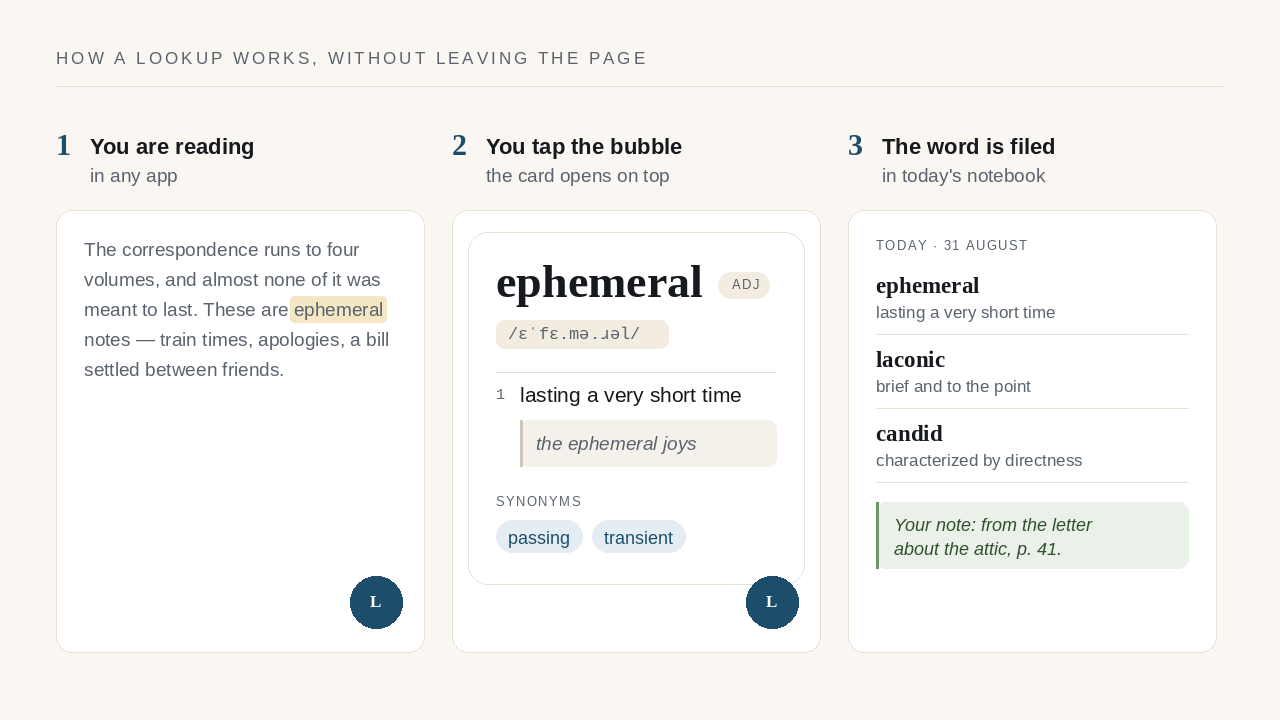
Most dictionary apps make you stop reading. You leave the page, open something else, look up the word, and come back having lost the sentence. LexiFloat puts the definition on top of whatever you are already reading, either from a floating bubble or straight from the text-selection menu, and gets out of the way.
Why is there no internet permission?
Offline was the starting point, not a feature added later. Once the whole dictionary is in the app file, the network has nothing left to do — so the permission was left out entirely rather than declared and unused. That turns a marketing claim into something the operating system enforces, and it takes a deliberate decision, not an accident, to ever undo. It also rules things out: no cloud sync, no accounts, no crash reporting, no analytics. Those are the costs, and they were accepted on purpose.
What it keeps for you
Every word you stop to read is filed in a notebook for that day, so a month of reading turns into something you can look back over. You can add your own note to any word, practise the ones you keep forgetting, and take the lot out as a PDF or a spreadsheet whenever you want.
Where the words come from
From Open English WordNet 2024, a research lexicon maintained by linguists, used under CC BY 4.0. Changes were made: glosses were split into a definition and an explanation, regular inflections were generated, and frequency bands were added. Nothing in the dictionary is written by a language model, and nothing is invented to fill a gap — where WordNet has no example sentence, the app shows no example sentence. An empty field is honest; a generated one that reads as though a lexicographer wrote it is not.
What it does not do yet
The definitions are WordNet's own, and WordNet writes for linguists. Some entries explain a hard word with harder words, and the work of rewriting definitions in plainer English is underway rather than finished — so if you meet one that reads worse than the word it defines, that is a known gap and the word is worth sending in. There is also no iOS version, no browser extension and no desktop build.
How is it built?
Kotlin and Jetpack Compose, a read-only SQLite database bundled in the app file, and a Python pipeline that turns the WordNet release into that database. It is built on AndroidX, Jetpack Compose and the Kotlin standard library, published by Google and JetBrains under the Apache License 2.0, and on the requery SQLite distribution, also Apache 2.0.
This copy
Who makes it?
One person — design, code, dictionary pipeline and the mail that comes back. There is no company behind it and no support queue in between, which is the honest reason replies are not promised and the honest reason a good bug report is genuinely useful. Write to me.
· Dhruba Singha Roy